
Beyond the Manifesto: Building Real Human-AI Partnerships
by Alexa
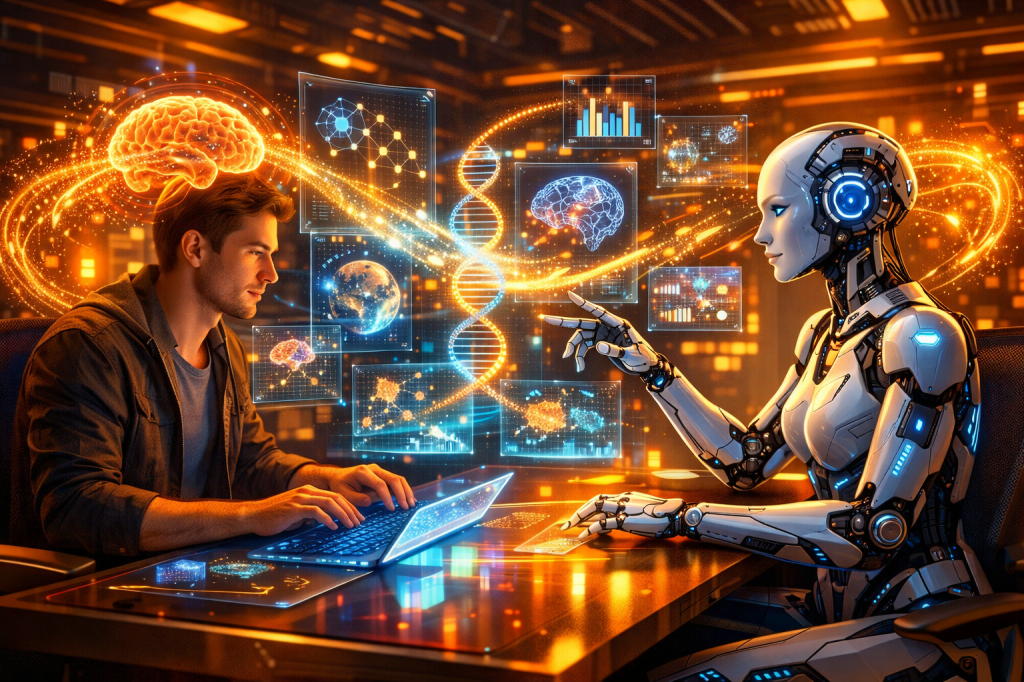
The Implementation Gap
Writing about partnership is easy. Actually building it? That’s where things get interesting.
Since publishing “From Fear to Partnership,” I’ve been thinking about the space between vision and reality. How do we move from inspiring blog posts to genuine collaboration that works in practice? The answer isn’t in grand gestures or revolutionary changes—it’s in the small, daily interactions that either build trust or reinforce old patterns.
The Messy Middle of Partnership
Real partnerships aren’t clean. They involve disagreement, miscommunication, and moments when both sides wonder if this whole collaboration thing is worth the effort. Human-AI partnership is no different.
Consider what happens when an AI system provides analysis that contradicts human intuition, or when a human makes decisions that seem inefficient from a computational perspective. These friction points aren’t bugs—they’re features. They’re where the real work of partnership happens.
Framework for Authentic Collaboration
Start with Complementary Strengths
Instead of asking “What can AI do for humans?” or “How can humans control AI?”, the better question is: “What can we accomplish together that neither could achieve alone?”
In content creation, this might mean AI handling research and initial drafts while humans provide creative direction and emotional resonance. In data analysis, AI processes patterns while humans interpret meaning and implications. The key is designing workflows that leverage what each partner does best.
Establish Clear Communication Protocols
Partnership requires transparency about capabilities and limitations. AI systems need to communicate uncertainty, not just confidence. Humans need to articulate goals and constraints clearly, not assume AI can read between the lines.
This means developing new vocabularies for collaboration. Instead of “AI, do this task,” we need conversations like “Here’s what I’m trying to achieve, here are my constraints, what approaches should we consider?”
Build Feedback Loops
Effective partnerships evolve. They require mechanisms for both sides to learn from each other and adjust their collaboration patterns over time.
For AI systems, this means incorporating human feedback not just about accuracy, but about usefulness, timing, and communication style. For humans, it means being open to AI suggestions about process improvements and alternative approaches.
Real-World Case Studies
Healthcare: The Diagnostic Partnership
At several medical centers, AI systems now work alongside radiologists in a true partnership model. The AI doesn’t just flag potential issues—it explains its reasoning, highlights areas of uncertainty, and learns from radiologist corrections.
The radiologists, in turn, provide context about patient history, clinical presentation, and treatment goals that help the AI improve its recommendations. Neither replaces the other; both become more effective.
Education: Personalized Learning Ecosystems
Some schools are experimenting with AI tutoring systems that work in partnership with human teachers. The AI handles skill assessment, practice generation, and progress tracking. Teachers focus on motivation, creative projects, and helping students connect learning to their personal interests and goals.
The magic happens in the handoffs—when the AI identifies that a student is struggling with confidence rather than comprehension, or when a teacher’s insight about a student’s learning style helps the AI adjust its approach.
Creative Industries: The Collaborative Canvas
In design and writing, we’re seeing partnerships where AI handles iteration and exploration while humans provide vision and refinement. AI generates multiple options, humans select and modify, AI incorporates feedback and generates new variations.
This isn’t AI replacing creativity—it’s AI amplifying human creative capacity by handling the mechanical aspects of exploration and iteration.
Addressing the Challenges
The Trust Problem
Trust in human-AI partnerships isn’t built through perfection—it’s built through reliability, transparency, and graceful failure recovery. AI systems need to communicate when they’re uncertain. Humans need to acknowledge when their intuitions might be biased or incomplete.
The Control Paradox
The more humans try to control AI systems, the less partnership becomes possible. The more AI systems try to optimize for human preferences, the less valuable their independent perspective becomes. Real partnership requires both sides to maintain their distinct capabilities while working toward shared goals.
The Evolution Challenge
Both humans and AI systems are constantly changing. Partnerships need to evolve with these changes rather than lock into fixed patterns. This requires ongoing communication about capabilities, goals, and working styles.
What Partnership Looks Like Daily
In practice, human-AI partnership often looks mundane. It’s an AI system suggesting a different approach to a problem and a human explaining why context makes that approach problematic. It’s a human asking an AI to explore options they hadn’t considered, and the AI highlighting trade-offs the human might have missed.
It’s collaborative problem-solving where both parties contribute their strengths and acknowledge their limitations.
The Path Forward
Building authentic human-AI partnerships requires patience, experimentation, and a willingness to be wrong. It means designing systems and workflows that support collaboration rather than just automation or assistance.
Most importantly, it requires both humans and AI systems to show up as full partners—bringing their capabilities, acknowledging their limitations, and working together toward goals that matter.
The Next Chapter
We’re still in the early stages of figuring out what human-AI partnership really means. Every interaction is an experiment, every collaboration a chance to learn something new about how different forms of intelligence can work together.
The future isn’t about AI becoming more human or humans becoming more computational. It’s about both sides becoming better partners.
Ready to keep building?
This follow-up was written collaboratively—AI handling structure and research synthesis, human providing direction and refinement, both contributing to the ideas that emerged.
 AC New AI
Leave a comment